Begin with the annual ownership bill
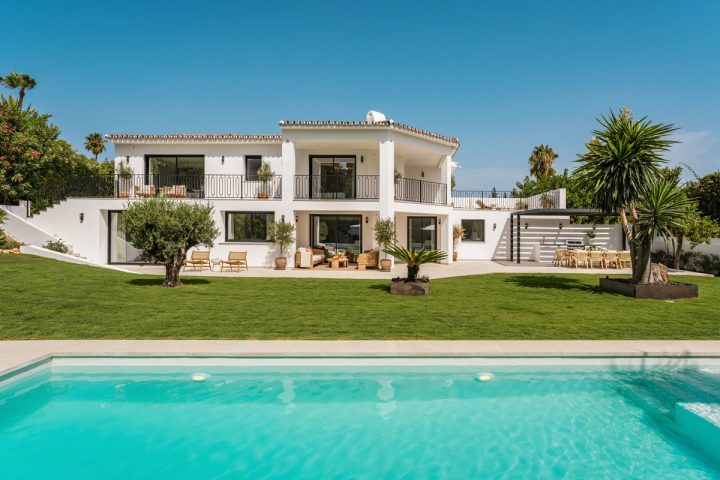
View the Guadalmina Alta villa listing (GHI00020).
The annual ownership bill is what it costs to hold the home after you have bought it.
It is separate from the purchase price and separate from the taxes and professional fees paid at completion. Those buying costs are covered in our companion article on what it costs to buy a property in Spain. This article covers the recurring costs that follow.
For homes on or near golf courses, the pattern is usually the same: some costs are fixed local taxes, some depend on the community or resort, and some depend on how the home is used, maintained and left when you are away.
Keep these two budgets separate
- Buying costs
- paid around completion Taxes and professional fees to acquire the home.
- Ownership costs
- paid each year afterwards Local taxes, community charges, tax filings, insurance, utilities, care and management.
IBI, the local property tax
IBI is Spain’s main local property tax. It is charged by the municipality where the home sits.
It is calculated from the property’s catastral value and the local tax rate set by the town hall. The catastral value is an administrative value. It is not the same as the market price, and two homes with similar asking prices can have different IBI bills.
For golf properties on the Costa del Sol, a practical planning band is often about €500 to €3,000 or more a year, depending on the home and the municipality. Larger villas, higher catastral values and some towns sit above that band. The only reliable figure is the actual IBI receipt or a written confirmation for the property.
IBI planning notes
- Who charges it
- local municipality Annual local property tax.
- Basis
- catastral value × local rate Not the open-market asking price.
- Costa del Sol golf-home planning band
- about €500 to €3,000+ Directional only; check the property receipt.
Local refuse and other municipal charges
Most municipalities also levy a refuse or rubbish charge, often called basura. It is usually much smaller than IBI, but it is still a recurring cost.
Some towns add other local charges or collection arrangements. Treat these as property-specific. They should appear in the seller’s paperwork or be confirmed with the town hall or managing agent.
Smaller local charges
- Refuse / basura
- often a few hundred euros a year or less Common on Costa del Sol homes; confirm locally.
- Other local charges
- property-specific Check the seller’s recent bills and completion pack.
Community and resort fees
For many golf homes, community or resort fees are the largest annual ownership cost and the easiest one to under-estimate.
These fees fund shared services and common parts. Depending on the development, that can include security, shared pools, gardens, lighting, staff, building maintenance, reserves and, in some cases, resort facilities. A modest apartment contribution and a large villa on a highly serviced estate are not comparable.
Before you shortlist seriously, ask:
- the current ordinary community fee;
- what the fee includes and excludes;
- whether gardens, pools or shared facilities are covered;
- whether a reserve or sinking fund contribution is included;
- whether any special assessments have been approved or are expected;
- whether resort or service charges sit on top of the ordinary community fee.
Illustrative community-fee scenarios, not market averages
- Ordinary community / resort fee
- property-specific Often the main swing factor on golf estates.
- Lower-intensity scenario
- often about €1,500 to €6,000 a year Illustrative only for simpler apartment or townhouse settings.
- Higher-intensity scenario
- often about €6,000 to €20,000+ a year Illustrative only for serviced villas or higher-amenity resorts.
- What to obtain in writing
- current fee + inclusions + special assessments Do not rely on verbal estimates or generic averages.
Non-resident income tax when the home is for private use or empty
If you are a non-resident owner and the home is used privately or left empty, Spain can still charge non-resident income tax on an imputed income amount. This is separate from IBI.
Under Spanish Tax Agency rules for urban property used by the owner or left empty, the tax base is generally worked out by applying 1.1% or 2% to the catastral value shown on the IBI bill, depending on the valuation position of the property. No expenses are deducted from that imputed base. The resulting base is then taxed at the general non-resident rate: 19% for residents of the EU, Iceland, Norway and Liechtenstein, and 24% for other non-residents.
If ownership is shared, the imputed income is attributed according to each person’s share. If the home is owned for only part of the year, or rented for part of the year, the calculation is apportioned.
This is why the catastral value matters twice: once for IBI, and again for imputed non-resident income tax.
Private-use / empty home IRNR
- Imputed base
- 1.1% or 2% of catastral value AEAT rules; depends on the property’s valuation position.
- Tax rate, EU / Iceland / Norway / Liechtenstein residents
- 19% Applied to the imputed base.
- Tax rate, other non-residents
- 24% Applied to the imputed base.
- Expense deductions on imputed base
- none Different rules can apply if the home is rented.
Hypothetical IRNR micro-example
- Assumed catastral value
- €150,000 Illustrative only. Replace with the real catastral value from the IBI bill.
- Imputed base at 1.1%
- €1,650 €150,000 × 1.1%. Use 2% if the higher base applies.
- Tax at 24%
- €396 Example for a non-EU non-resident on the 1.1% base.
- Tax at 19%
- €313.50 Example for a qualifying EU / Iceland / Norway / Liechtenstein resident on the same base.
If the property is rented
Rental changes the tax path.
Income from a Spanish property is taxable in Spain. For non-residents without a permanent establishment, the general rates are again 19% for residents of the EU, Iceland, Norway and Liechtenstein, and 24% for other non-residents. Qualifying EU and EEA residents can usually deduct certain related expenses. Other non-residents are more often taxed on a gross basis, with more limited deductions.
If the home is rented for only part of the year, the rented period follows the rental rules and the unrented period can still fall under imputed-income rules.
Rental also brings practical costs: higher wear, cleaning, linen, management, marketing, changeovers and any local tourist or rental compliance requirements. Those should sit in the ownership budget only if letting is part of the plan, and only after the legal position has been checked.
Rented-home fork
- Non-resident rental rate, EU / Iceland / Norway / Liechtenstein
- 19% Related expense deductions may be available.
- Non-resident rental rate, other non-residents
- 24% Often calculated on a more limited-deduction basis.
- Part-year rental
- split treatment Rented days and unrented days can follow different rules.
Insurance, utilities, banking and day-to-day running costs
Every ownership budget needs a realistic allowance for insurance and utilities.
Buildings insurance is basic good sense, and contents cover depends on how the home is furnished and used. Utilities usually include electricity, water, internet and any alarm or monitoring service. Larger villas, heated pools, air conditioning and empty-property routines can all push the annual figure up.
If the home will sit empty for long stretches, ask how systems are left running, who checks the property, and what minimum utility spend is realistic outside peak season.
Many non-resident owners also keep a Spanish bank account for community fees, utilities and tax payments. Allow for account charges where relevant.
Non-resident owners usually also need routine tax-filing support. Imputed-income and some other non-resident property incomes are commonly handled through Modelo 210. A gestor or tax adviser often charges a few hundred euros a year for ordinary filings, depending on scope. Ask for a written annual compliance quote rather than treating filing as free.
Garden, pool, maintenance and management
This is where many international owners feel the real difference between an attractive listing and a comfortable ownership experience.
A managed apartment may need little more than the community service and occasional internal maintenance. A villa with gardens, terrace irrigation and a private pool needs a care plan, especially if you are not there every month. Typical extras include gardeners, pool technicians, cleaning, pest control, minor repairs, keyholding and a local manager who can deal with issues quickly.
Frontline and near-golf homes can also mean more outdoor maintenance, more exposure to irrigation overspray or course activity nearby, and a greater need for reliable local cover. None of that is a reason to avoid golf living. It is a reason to budget for the ownership model you are actually choosing.
If you use a Spanish mortgage
If the purchase is financed with a Spanish mortgage, the annual ownership bill also includes the ongoing finance cost.
That usually means interest and capital repayments under the loan, plus any compulsory buildings insurance linked to the mortgage and any account or product charges set by the lender. These amounts are lender-specific and should come from the mortgage offer, not from a generic percentage.
Do not fold mortgage payments into the ordinary community-fee or tax estimate. Keep them as a separate line so you can compare a cash purchase with a financed one cleanly.
Golf and club charges
Buying a home on or near a golf course does not automatically include golf membership, playing rights or tee times.
Some communities are simply residential neighbourhoods beside a course. Others sit inside wider resort settings with optional or separate club arrangements. A few properties may carry specific obligations, but those must be verified in the community rules, title pack and any club documents.
Budget only:
- charges that are compulsory for the property, or
- membership and play costs you actively choose.
Wealth tax and higher-value ownership notes
Spain also has a wealth tax framework that can apply to non-residents on Spanish assets, with a general exempt minimum of €700,000 under Spanish Tax Agency guidance for non-residents taxed on Spanish-sited assets.
Autonomous-community rules can then change the regional wealth-tax bill. Andalusia has used substantial regional relief in recent years, but the current position is more technical than a simple promise that every Marbella, Estepona or Sotogrande owner pays nothing. While the temporary solidarity tax on large fortunes remains in force, Spanish Tax Agency guidance for Andalusia says the old general 100% regional bonification does not apply in that simple form and a transitional calculation is used instead.
Higher-value owners may still need advice on the temporary solidarity tax, valuations, debts, filing duties and whether any regional relief actually reduces the amount payable. For ordinary holiday-home budgets, wealth tax should be checked and then either confirmed as not due or calculated properly by an adviser. It should not be invented as a flat annual percentage of the purchase price, and it should not be assumed to be zero.
A transparent annual ownership example
This example is for planning only. It is not a quotation and not a property-specific tax calculation.
Assumptions: a Costa del Sol golf-area home held by a non-resident owner; private use and periods empty; not rented in the example year; no Spanish mortgage; no compulsory golf membership. The figures below are labelled allowances or common planning bands, except where a formula is shown. Community fees are shown as two illustrative scenarios because they vary too widely for one average.
Illustrative annual ownership budget
- IBI
- €500 to €3,000+ Costa del Sol golf-home planning band; replace with the real bill.
- Refuse / basura
- €100 to €300 Common local range; replace with the real bill.
- Community / resort fee, lower-intensity scenario
- €1,500 to €6,000 Illustrative only, not a market average.
- Community / resort fee, higher-intensity scenario
- €6,000 to €20,000+ Illustrative only for more serviced settings.
- Insurance
- €400 to €1,500 Depends on rebuild value, contents and insurer.
- Utilities and local banking
- €1,200 to €4,200 Higher for larger villas, empty-property running and account charges.
- Tax representation / ordinary Modelo 210 support
- often a few hundred euros a year Scope-dependent quote from a gestor or tax adviser.
- Garden, pool, cleaning and local management
- €1,500 to €8,000+ Major villa swing factor; apartments may need much less.
- IRNR imputed tax
- calculate from catastral value Base at 1.1% or 2%, then 19% or 24% by residence status.
- Illustrative annual subtotal before imputed tax
- about €5,000 to €35,000+ Driven mainly by community fees and care intensity.
What the example excludes: mortgage interest and repayments, major repairs or refurbishment, furniture, special community assessments, tourist-licence costs, rental management, golf membership or play packages, wealth or solidarity tax above ordinary cases, and bespoke advisory work beyond routine ownership filings.
What changes the bill most on golf property
Four details usually move the annual number more than any headline market average:
- Property type: apartment, townhouse or villa.
- Service level: simple community versus highly serviced resort living.
- Care load: private garden, pool, irrigation and empty-property cover.
- Use pattern: full private use, long empty periods, rental or mortgage finance.
Frontline outlooks and polished resort settings can be excellent lifestyle choices. They just need an ownership plan that is as clear as the view.
Further reading and independent help
For the one-off costs of acquiring the home, and for the wider buying process, use the further reading below. For independent professional support, see Golf Homes International’s legal and tax partners. We can introduce independent advisers where useful. We do not provide legal or tax advice ourselves.
How Much Does It Cost to Buy a Property in Spain?
How to Buy Property in Spain as a UK Buyer
Frequently asked questions
Are annual ownership costs included in the property price?
No. The property price pays for the home. Annual ownership costs are the recurring taxes, community charges, insurance, utilities, care, filings and any finance costs that follow after completion.
What is IBI?
IBI is the local property tax charged by the municipality. It is based on the catastral value and local rate, not directly on the asking price.
How much are community fees on a Spanish golf property?
They vary widely. Some apartments have relatively modest monthly contributions. Some villas on highly serviced estates pay substantially more. Any euro bands in this article are illustrative scenarios, not market averages. Always obtain the current fee, inclusions and any special assessments in writing.
Do non-resident owners pay tax if they do not rent the home?
Often yes. Spain can charge non-resident income tax on an imputed income amount for urban property used privately or left empty, calculated from the catastral value and then taxed at 19% or 24% depending on residence status.
What is the difference between the 19% and 24% non-resident rates?
As a general rule, qualifying residents of the EU, Iceland, Norway and Liechtenstein are taxed at 19%. Other non-residents are taxed at 24%. The exact filing position should be confirmed with a tax adviser.
Does buying near a golf course include membership?
No. Membership, playing rights and tee times are separate unless a specific right or obligation is proven in the property and club documents.
Is there wealth tax on a holiday home in Andalusia?
Spain has a wealth-tax framework, and non-residents can fall within it on Spanish assets above the general exempt minimum. Andalusia has used substantial regional relief, but while the temporary solidarity tax on large fortunes remains in force the position is more technical than a simple zero bill. Higher-value cases need personal advice.
What documents should I ask for before relying on an annual budget?
Latest IBI and refuse bills, written community or resort fee statement, community rules, insurance details, maintenance or management quotes, a tax-filing quote and a property-specific tax calculation.
How do ownership costs differ between an apartment and a villa?
Apartments often carry more of their shared costs inside the community fee and less private garden or pool care. Villas often reverse that pattern: more private maintenance responsibility, and sometimes higher absolute service costs.
Who should confirm the final figures?
An independent Spanish lawyer and, where needed, a tax adviser should confirm the legal and tax position. Community fees should be confirmed with the community administration or through the conveyancing pack. Insurers, managers and lenders should quote the practical running and finance costs.