The short answer
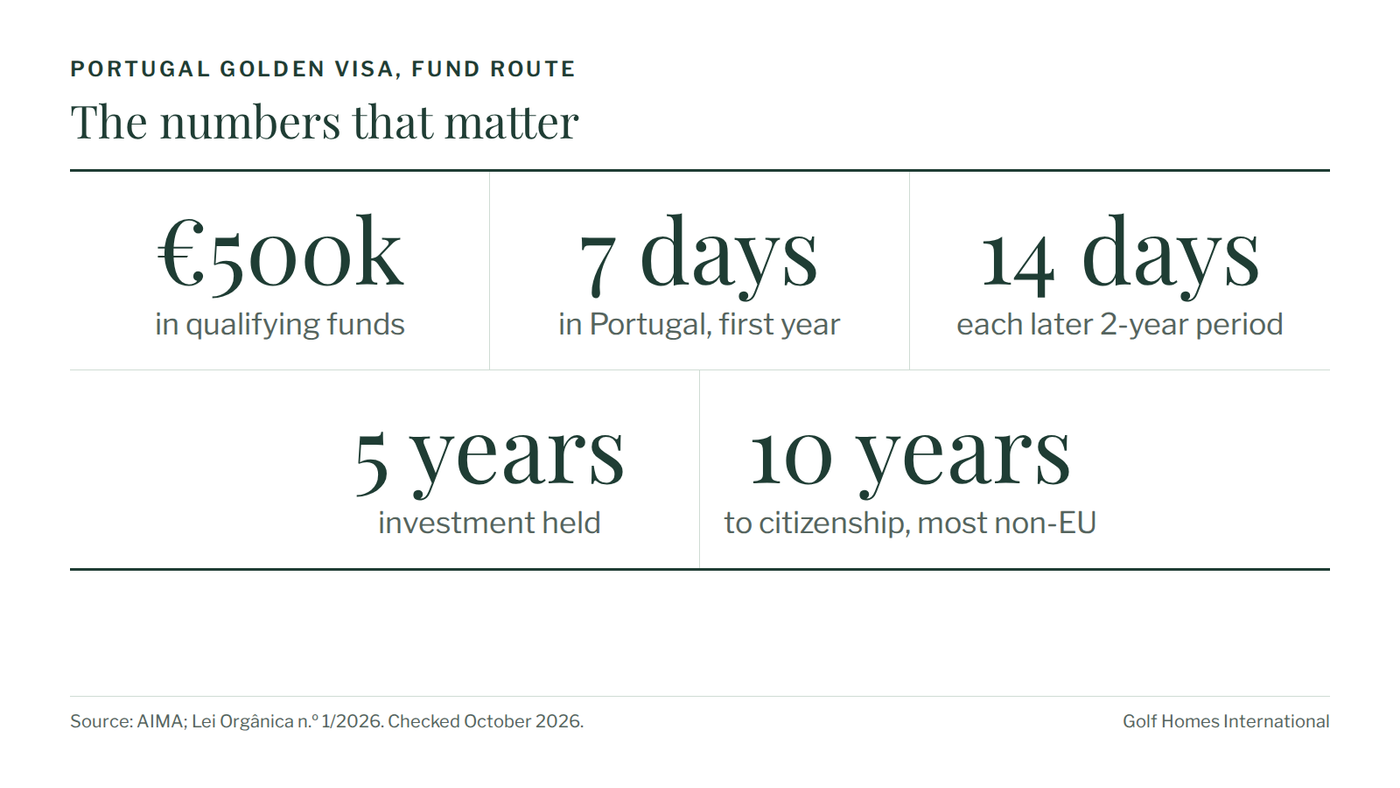
Yes. Portugal's Golden Visa is open to non-EU nationals in 2026, including UK, US, Indian and South African citizens, and its light stay requirement keeps it attractive to international investors. The most common route today is a €500,000 investment in qualifying Portuguese investment funds. It needs no property purchase, no business to run and only 7 days in Portugal in the first year. The one thing that has changed is property: since 7 October 2023, buying a home no longer counts towards the Golden Visa.
At Golf Homes International, many of our international buyers ask about residency alongside a home in Portugal. This guide sets out what qualifies in 2026, how the fund route works, what the Golden Visa gives you, and how residency and a home purchase fit together.
Facts in this article were last checked against official Portuguese sources on 23 October 2026. Rules change, so confirm the position with a qualified lawyer before you act.
What changed for property in 2023
Portugal's Golden Visa, formally the Autorização de Residência para Investimento (ARI), launched in 2012. For a decade the best known route was buying property, usually from €500,000. The Mais Habitação housing law (Lei n.º 56/2023) removed every real estate route, along with the €1.5 million capital transfer route, from 7 October 2023.
The rule is now explicit. Portugal's immigration agency, AIMA, states that a qualifying investment cannot be aimed, directly or indirectly, at real estate. That applies to the investment funds as well: a fund that buys property does not qualify.
People who applied under the old property route before the change were protected by transitional rules. For anyone starting today, residency and a home are simply two separate decisions, and many Golden Visa investors do both: they qualify through funds, and buy a home they want to spend time in.
Portugal Golden Visa requirements in 2026: what qualifies
AIMA lists the current investment routes on its Golden Visa page. None of them involve buying property. The minimums below were last checked on 23 October 2026.
Portugal Golden Visa routes and minimums, 2026
- Investment funds
- €500,000 Units in Portuguese funds that do not invest in real estate; maturity of at least 5 years at the time of investment; at least 60% invested in companies based in Portugal
- Company creation or recapitalisation
- €500,000 A Portuguese company, with 5 new permanent jobs, or 10 jobs kept (at least 5 permanent) for at least 3 years
- Scientific research
- €500,000 €400,000 in low-density areas
- Arts or national cultural heritage
- €250,000 Support for artistic production or heritage recovery
- Job creation
- 10 jobs No set investment amount
For most private investors the fund route is the natural choice. There is no business to run and no property to buy, manage or let, the amount is clear, and the investment is handled by a regulated fund manager. The research, culture and job creation routes tend to suit people who already have a specific project in Portugal.
One point causes confusion. The €250,000 route is for arts and cultural heritage, not funds. Some funds accept subscriptions from a lower amount, but a Golden Visa through the fund route still needs a total of €500,000.
Who is eligible?
The Golden Visa is for nationals of countries outside the EU, the EEA and Switzerland. Since Brexit that includes UK citizens, alongside buyers from the US, the UAE, India, South Africa and elsewhere. EU citizens do not need it, because they can already live in Portugal.
Alongside the investment, applicants generally need:
- a clean criminal record, with no entry ban in the Schengen Area;
- the investment made with money transferred from abroad, and evidence of where it came from;
- a Portuguese tax number (NIF);
- to keep the investment for at least 5 years;
- to meet the minimum stay rule, set out below.
Your lawyer will confirm the full document list, which can vary with your nationality and family.
How the Golden Visa investment fund route works
The €500,000 can sit in one qualifying fund or be spread across several, as long as the total meets the legal minimum and the money arrives by transfer from abroad. Each fund manager provides a declaration confirming the fund meets the rules. There is no official public list of “Golden Visa funds”, so every fund needs checking on its own terms. Fund managers in Portugal are supervised by the securities regulator, the CMVM.
In practice, the process tends to run in this order. Your lawyer will confirm the exact documents for your circumstances.
-
Get a Portuguese tax number and bank account
A NIF (tax number) and a Portuguese bank account are needed before you invest, and can usually be arranged remotely through a representative.
-
Take independent advice
Speak to a lawyer on the immigration side and a regulated financial adviser on the investment itself, before you sign anything.
-
Subscribe to one or more qualifying funds
The money is transferred from abroad, and the total across funds must reach €500,000.
-
Collect the fund manager declarations
Each manager confirms the 5-year maturity and the 60% Portugal investment test, which AIMA requires.
-
Apply to AIMA
Your lawyer submits the application; biometrics are taken at an AIMA appointment in Portugal.
-
Receive a 2-year residence card
The card is then renewed for further 2-year periods while you keep the investment and meet the stay rule.
-
Plan for year five and beyond
After 5 years you may apply for permanent residence, and later citizenship, if you meet the conditions at the time.
AIMA does not publish a processing time and demand is high, so plan the timing with your lawyer rather than to a fixed date. Since February 2026, renewals have been handled through AIMA's online renewal portal.
What the Golden Visa gives you, and what it does not
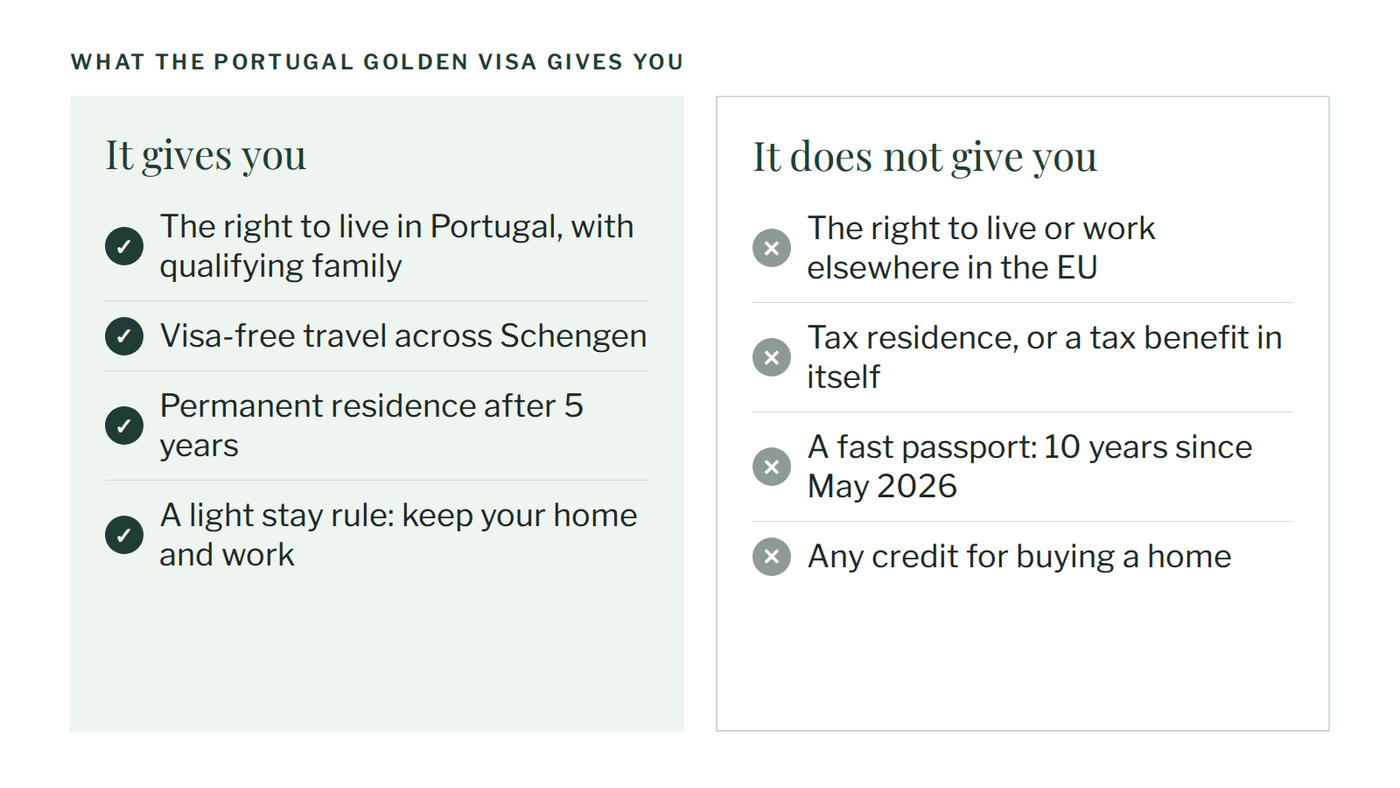
The Golden Visa is a residence permit, and a valuable one: it gives you the right to live in Portugal while asking for very little time there. It is also worth being clear about what it does not do.
Key Golden Visa timings
- Minimum stay, first year
- 7 days Set by AIMA
- Minimum stay, later periods
- 14 days In each later period, usually read as each 2-year renewal
- Residence card
- 2 years Then renewed in 2-year periods
- Investment held
- 5 years From the date the permit is granted
- Permanent residence
- After 5 years Conditions apply, including basic Portuguese (A2)
- Citizenship
- 10 years Most non-EU nationals; 7 years for EU and Portuguese-speaking countries
The citizenship change comes from Lei Orgânica n.º 1/2026, in force from 19 May 2026. Two details matter for new applicants. Time spent waiting for a residence permit no longer counts automatically towards the 10 years, and applicants must now show knowledge of Portuguese culture, citizens' rights and how the state is organised. Applications already pending on 19 May 2026 stay under the old rules.
On tax, the Golden Visa does not make you tax resident in Portugal, and it does not bring tax benefits by itself. If you later move to Portugal full-time, your tax position changes. The former Non-Habitual Resident (NHR) regime closed to new entrants in 2024. Its replacement, IFICI, covers qualifying work income in specific sectors, so it does not help retirees or most passive investors. Take tax advice in both countries before you move.
Choosing a Golden Visa fund: the questions to ask
Golden Visa funds are investments, and they differ in strategy, fees, risk and how long your money is committed, so choosing well matters as much as qualifying. These are the questions we would expect any careful investor to put to a fund manager and to their own adviser.
-
Is the manager authorised, and by whom?
Check the manager and the fund on the CMVM register, and read the fund rules and Key Information Document in full.
-
Does the fund meet the Golden Visa tests?
Ask for confirmation of the 5-year maturity, the 60% Portugal test and the exclusion of real estate, and for the declaration AIMA needs.
-
What is the risk rating?
The Key Information Document gives a risk class. Funds of this kind can lose some or all of the money invested.
-
How long is your money tied up?
Many funds are closed-ended, with no early exit except in limited legal cases, and pay out only when the fund ends.
-
What are all the fees?
Ask for set-up, management, performance and depositary fees, and how they affect what you receive.
-
What happens if the fund ends before you need it to?
Your residence depends on keeping a qualifying investment, so the fund term and your permit timeline need to line up.
-
Who handles the AIMA paperwork?
Ask whether the manager works with independent lawyers, and whether you can use your own.
-
How are returns described?
A target return is not a promise. Ask how it is calculated, and what happens in a poor market.
Why international investors choose Portugal
The Golden Visa is popular because of the country behind it. Portugal was named Economy of the Year for 2025 by The Economist, ahead of the other 35 economies in its annual ranking, for combining strong growth, low inflation and a rising stock market. It is regularly placed among the safest countries in the world, and has a well-established international school sector around Lisbon, Cascais and the Algarve.
For many of our buyers, the lifestyle is the real draw. The Algarve has a long, mild season, sandy beaches and some of the best-known golf in Europe, from Monte Rei in the east to Vilamoura and its Old Course, Vale do Lobo and Quinta do Lago. Faro airport puts most of the coast within a short drive, and Lisbon has direct flights to North America and Brazil.

With a stay rule of only 7 days in the first year, the Golden Visa suits people who want a foothold in Europe now, while keeping their current home, work and tax base. Others use it as a first step towards moving later.
Portugal compared: the UK, France and Spain
How does the Golden Visa compare with the routes an international investor has to live in the UK, France or Spain in 2026? Of the four, Portugal is the only one that gives you European residence without moving there or running a business.
| Portugal | United Kingdom | France | Spain | |
|---|---|---|---|---|
| Investor visa | Open | Closed 17 Feb 2022 | Open | Closed 3 Apr 2025 |
| Route today | €500,000 in qualifying investment funds | Innovator Founder visa: an endorsed new business, no set investment | Talent Passport, investor: €300,000 into a French business you run or hold 30% of | Non-lucrative visa: passive income of €2,400 a month, no investment route |
| Must run a business? | No | Yes | Yes, creating or keeping jobs | No, and work is not allowed |
| Time you must spend there | 7 days in year one, then 14 per two-year period | Live there: for citizenship, no more than 450 days away in 5 years | Live there: a French address is required, and the permit is tied to your French business | Live there: more than 183 days a year |
| Buying a home counts? | No | No | No | No |
| Citizenship | After 10 years of legal residence | Usually after 5 years, with 12 months' settled status | After 5 years of habitual residence | After 10 years of legal residence |
General comparison only, checked 26 October 2026. Sources: AIMA and Lei Orgânica n.º 1/2026 (Portugal); GOV.UK (UK); Ministère de l'Intérieur, CESEDA and Code civil (France); Ley Orgánica 1/2025 and Real Decreto 1155/2024 (Spain).
- Where Portugal stands out
- It is the only route here that gives you European residence without moving there or running a business. Your money is professionally managed, and the stay rule is days, not months.
- Where it doesn't
- Buying a home does not count, the money is committed for at least five years, and citizenship takes ten. If you plan to move and build a business, France or the UK can lead to citizenship sooner.
UK citizens already have the right to live in the UK, so that column is for investors from elsewhere, and UK settlement rules are under review. This is a general comparison only, and each route carries conditions not shown here. Take legal advice in the country concerned.
What buyers do instead if they want to live in Portugal
Not everyone needs a Golden Visa. If your main aim is to live in Portugal, rather than keep a foothold while living elsewhere, a standard residence visa is often the simpler route, and it sits alongside a home purchase without any investment requirement.
Common alternatives to the Golden Visa, 2026
- D7 visa (passive income)
- €920 a month For pensions, rental and investment income; 2026 minimum for the main applicant
- D8 visa (remote work)
- €3,680 a month For people working remotely for employers or clients outside Portugal; 2026 minimum
- Golden Visa (fund route)
- €500,000 For those who want residency without moving; 7 days in year one
The D7 and D8 thresholds are tied to Portugal's minimum wage, so they rise each January. The D7 figure increases by 50% for a spouse and 30% for each child. Both visas expect you to live in Portugal, so you become tax resident there, which is a very different position from the Golden Visa. Check the current figures with the Portuguese consulate in your country before you apply.
UK nationals who simply want to spend time at a holiday home can stay up to 90 days in any 180 without a visa. Beyond that, they need one of the routes above.
Residency and a home: two separate decisions
Many Golden Visa investors also buy a home in Portugal. That is a perfectly sensible plan, as long as the two are treated as separate decisions. The home does not count towards the €500,000, the fund cannot invest in property, and nothing about one should be presented as part of the other.
If you are thinking of doing both, two practical points are worth knowing before you start.
Purchase tax for non-residents changed in 2026. Under Decreto-Lei n.º 97/2026, which added a new rule to Article 17 of the IMT Code, a buyer who is not tax resident in Portugal now pays a flat 7.5% IMT (property transfer tax) on homes used only as housing, with no exemptions or reductions, whatever the price. The difference can be refunded if you become tax resident within 2 years of buying, so the timing of any move can affect what you pay. Stamp duty of 0.8% is also due. Ask your lawyer to confirm how the rules apply to the specific property, especially resort units with tourist classification.
Keep the money flows separate. Your lawyer will want a clear record that the Golden Visa investment came from abroad and went into qualifying funds, with the property purchase funded and documented on its own.

For a full breakdown of purchase costs, see our guide to how much it costs to buy a property in Portugal, our practical guide to whether foreigners can buy property in Portugal, and six financial questions to ask before you buy in Portugal.
FAQ
Who is eligible for a Portugal Golden Visa?
Nationals of countries outside the EU, the EEA and Switzerland who make a qualifying investment, have a clean criminal record and meet the minimum stay rule. That includes UK citizens since Brexit.
Can UK citizens apply for a Portugal Golden Visa?
Yes. Since Brexit, UK citizens are non-EU nationals and can apply on the same terms as other non-EU investors. UK citizens who want to live in Portugal full-time often look at the D7 visa instead.
Is the Portugal Golden Visa still available in 2026?
Yes. It remains open to non-EU nationals through non-property routes. The most common is a €500,000 investment in qualifying Portuguese investment funds.
Can I get a Portugal Golden Visa by buying property?
No. Real estate routes were removed from 7 October 2023 by Lei n.º 56/2023, and AIMA states that a qualifying investment cannot be aimed, directly or indirectly, at real estate. You can still buy a home in Portugal, but it does not count towards the Golden Visa. Many investors qualify through the fund route and buy a home separately.
How much money do I need for a Portugal Golden Visa?
For the fund route, €500,000 in total. It can be spread across more than one qualifying fund, provided the total meets the minimum and the money is transferred from abroad. A fund with a lower minimum subscription does not, on its own, meet the requirement. Budget separately for legal fees and AIMA government fees.
How long do I need to spend in Portugal?
At least 7 days in the first year, and at least 14 days in each later period, which is generally read as each 2-year renewal period.
Does the Golden Visa lead to citizenship?
It can, but it now takes longer. Since 19 May 2026, most non-EU nationals need 10 years of legal residence, plus language, knowledge and civic requirements. Nationals of EU and Portuguese-speaking countries need 7 years. Permanent residence is possible after 5 years if the conditions are met.
What happens after 10 years of a Golden Visa?
If you have held legal residence for 10 years and meet the other conditions, including language, knowledge and civic requirements, you can apply for Portuguese citizenship. Many holders apply for permanent residence earlier, after 5 years.
Can my family be included?
Usually, yes. A spouse or partner and dependent children can normally be included, and in some cases dependent parents. Your lawyer will confirm who qualifies and what documents are needed.
Can I live and work anywhere in the EU with a Portuguese Golden Visa?
No. It gives you the right to live in Portugal and to travel visa-free within the Schengen Area for up to 90 days in any 180. Living or working in another EU country needs that country's permission.
Is my investment guaranteed?
No. Golden Visa funds are investments, and you can lose some or all of the money you put in. Read the fund's own documents and take regulated financial advice before investing.
Does the Golden Visa give me tax benefits?
Not by itself. It does not make you tax resident. If you later become tax resident in Portugal, normal Portuguese tax rules apply, subject to any tax treaty. The old NHR regime is closed to new entrants.
How long does a Golden Visa application take?
There is no official processing time, and AIMA has a significant backlog. Treat any fixed timeline with caution and plan with your lawyer.